Advent Day 15: Measuring habitat loss
Dec 15, 2025
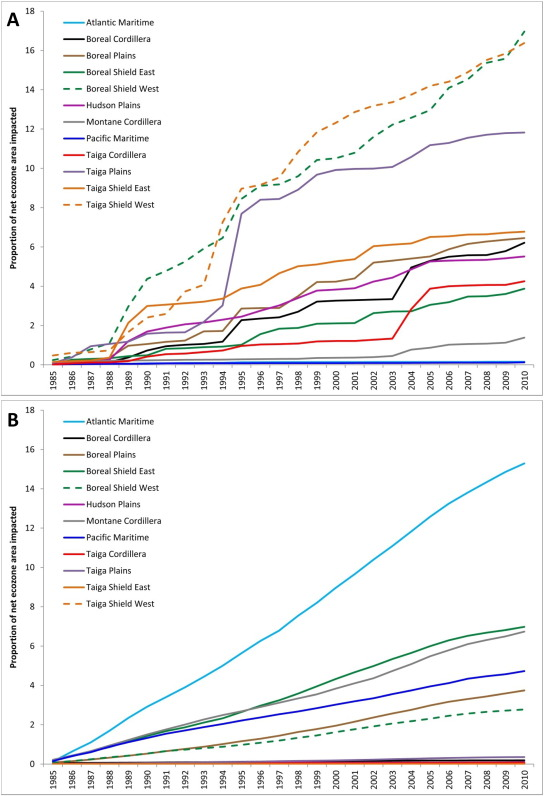
Disturbances such as fire, logging, storms, and land clearing produce abrupt, often stand-replacing changes in spectral and structural signals. These events drive habitat loss and fragmentation, reshaping connectivity, altering microclimates, and disrupting ecological processes. While field surveys capture local impacts, they struggle to quantify disturbance consistently across large areas, like understanding wildfire (top panel: A) and harvesting (bottom panel: B) disturbance by ecozone shown in the figure from White et al 2017.
Remote sensing detects disturbance through sharp changes in reflectance, greenness, canopy height, or radar backscatter, providing objective measures of extent and severity. Because these signals are spatially explicit, ecologists can distinguish between partial canopy loss, complete stand replacement, and fine-scale fragmentation patterns.
Common tools for disturbance detection include:
- Burn severity indices (e.g., NBR) for fire impacts
- Multi-temporal satellite time series for logging or land clearing
- Radar backscatter for storm damage and cloud-prone regions
- Lidar differencing for quantifying structural loss
Together, these approaches allow ecologists to move beyond binary maps of disturbed versus undisturbed, and toward quantifying how disturbance varies in space, severity, and type. This also supports disturbance agent attribution, linking observed habitat loss to specific drivers such as fire, harvest, or extreme weather, laying the groundwork for understanding ecological consequences and informing management decisions.
–
References
White, J. C., Wulder, M. A., Hermosilla, T., Coops, N. C., & Hobart, G. W. (2017). A nationwide annual characterization of 25 years of forest disturbance and recovery for Canada using Landsat time series. Remote Sensing of Environment, 194, 303–321. https://doi.org/10.1016/j.rse.2017.03.035