Advent Day 14: Detecting habitat degradation before it’s obvious
Dec 14, 2025
Habitat degradation often unfolds gradually, long before mortality or collapse becomes apparent in the field. Drought, heat stress, pests, and chronic disturbance can leave subtle but detectable signatures in remote sensing data, making it these data powerful tools for early detection of ecosystem stress.
Multi-temporal spectral and thermal observations capture changes in canopy water content, photosynthetic efficiency, surface temperature and greenness (as this figure from Huang et al 2019). Indices sensitive to moisture and stress reveal drying, heating, and reduced physiological function, signals that can precede visible dieback by months or even years. This allows ecologists to study vulnerability and stress trajectories, rather than only end states.
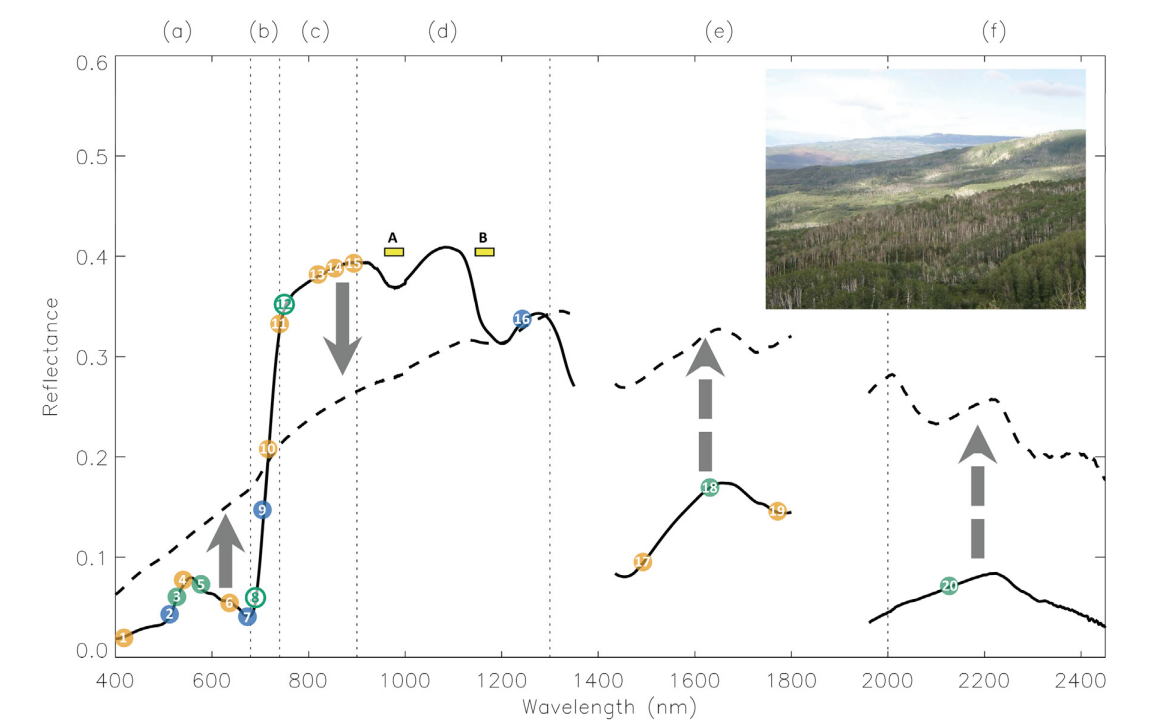
Spectral regions and indices used to detect degradation include:
- Thermal bands capturing canopy heating under water stress
- Shortwave infrared (SWIR) bands sensitive to vegetation water content
- Red-edge bands linked to chlorophyll content and stress
- Photochemical Reflectance Index (PRI) as a proxy for photosynthetic efficiency
Remote sensing transforms degradation from a post hoc diagnosis into a measurable process unfolding through time. Detecting stress early improves our ability to anticipate ecosystem change rather than react to collapse. Remote sensing supports proactive conservation and management by revealing where systems are vulnerable, maybe even approaching ecological limits.
–
References
Huang, C., Anderegg, W. R., & Asner, G. P. (2019). Remote sensing of forest die-off in the Anthropocene: From plant ecophysiology to canopy structure. Remote Sensing of Environment, 231. https://doi.org/10.1016/j.rse.2019.111233