Advent Day 12: Mapping where species can live
Dec 12, 2025
Species distribution models (SDMs, also called ecological niche models or ENMs) link observations of where species occur to environmental conditions, allowing ecologists to infer habitat suitability across unsampled space and time. Remote sensing has become central to this effort because it provides spatially continuous, ecologically meaningful predictors that reflect the conditions individuals actually experience across spatial scales .
From remote sensing data, ecologists can derive variables such as canopy height, greenness, surface moisture, snow persistence, temperature proxies and topographic metrics. These layers capture habitat structure, productivity, and stress at spatial and temporal scales that align closely with species’ niches. Importantly, they can be paired not only with species occurrence data, but also with functionally relevant responses such as nesting success, brood survival, or habitat use intensity.
Remote sensing information commonly used in SDMs include:
- Vegetation indices as proxies for productivity and resource availability
- Canopy height and cover as measures of habitat structure
- Moisture and snow metrics that constrain seasonal access or survival
- Terrain variables that shape microclimate and exposure
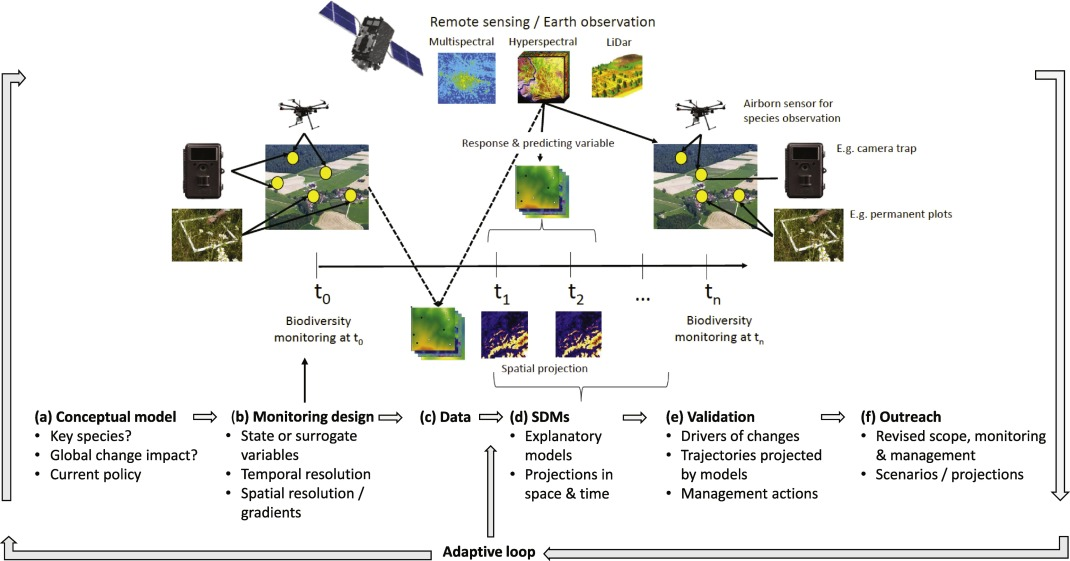
Remote sensing pushes SDMs beyond static climate envelopes toward habitat-informed predictions that can evolve through time. Instead of being one-off static products, SDMs become part of a feedback loop wherein field data inform models, remote sensing helps identify drivers and predict change, and new observations are used to check and refine those predictions between field campaigns. Like Randin et al 2020 suggest and the figure above shows, this makes SDMs more dynamic, more testable, and far more useful for guiding conservation in a rapidly changing world.
–
References
Randin, C., Ashcroft, M., Payne, D., Randin, C. F., Ashcroft, M. B., Bolliger, J., Cavender-Bares, J., Coops, N. C., Dullinger, S., Dirnböck, T., Eckert, S., Ellis, E., Fernández, N., Giuliani, G., Guisan, A., Jetz, W., Joost, S., Karger, D., Lembrechts, J., & Lenoir, J. (2020). Monitoring biodiversity in the Anthropocene using remote sensing in species distribution models. Remote Sensing of Environment, 239. https://doi.org/10.1016/j.rse.2019.111626